The Lawn Was Never About Grass
The American lawn was never about aesthetics. It was a visible audit of social compliance, demanded by buried infrastructure and enforced by appraisers and HOAs. Now the system that required it is collapsing.
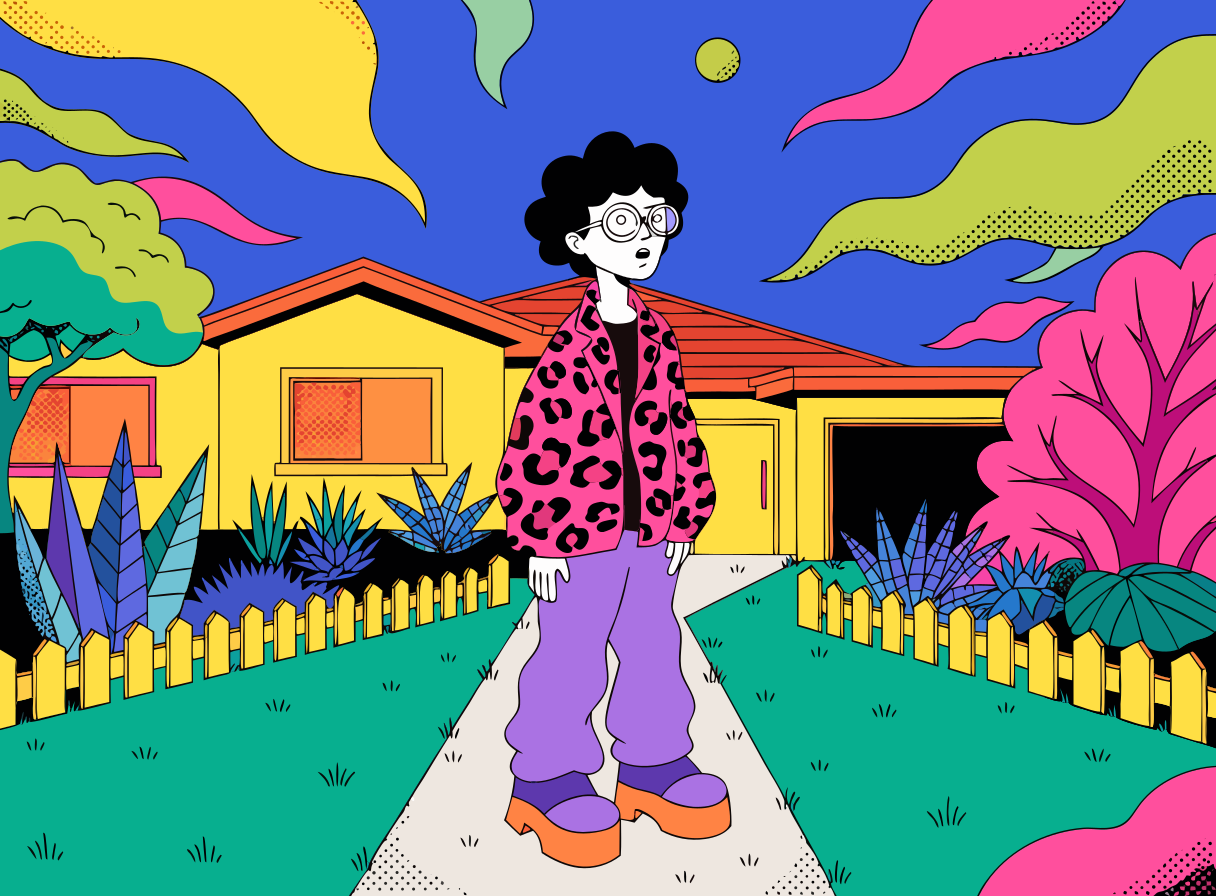
A drone hovers twelve inches above the front yard, blades spinning in precise, silent arcs. It doesn't pause for weeds. It doesn't care if the hydrangeas have bloomed into wild bursts of purple. It follows its algorithm: a geofenced rectangle of emerald turf, trimmed to the quarter-inch standard. A neighbor watches from behind her blinds and doesn't smile. She exhales. This is not progress. It is performance.
It's 2024, and the lawn is still here, but it is no longer a symbol of home. It is a covenant, a fossilized rule written in chlorophyll and irrigation lines, enforced by invisible infrastructure and automated obedience. And the people who once believed it made them safe are finally asking why they ever thought it was theirs.
The Lawn as Surveillance Infrastructure
Before there were security cameras, there was the front lawn. In 1948, an FHA appraiser in suburban New Jersey wrote in his evaluation report: "Property value significantly diminished due to lack of manicured lawn and presence of dandelions in front yard. Tenant appears unmotivated to maintain property standards. Neighborhood stability at risk." He did not mention crime rates. He did not cite structural defects. He cited grass.
The lawn was never about aesthetics. It was about visibility, a visual audit trail of social compliance. A neatly trimmed expanse of Bermuda or Kentucky bluegrass signaled order, discipline, and above all conformity. The absence of weeds was not a sign of care but a proxy for moral reliability. A brown patch was a red flag. A vegetable garden read as economic desperation or racial otherness. A shrub taller than three feet was a potential hiding place. This wasn't anecdotal; it was policy. The Federal Housing Administration's 1936 Underwriting Manual explicitly listed lack of lawn maintenance as a criterion for devaluing properties, alongside incompatible racial groups and close proximity to industrial zones. The lawn didn't just reflect status. It defined it, and that definition was inseparable from race, class, and exclusion.
Consider Levittown, Pennsylvania, the first mass-produced suburb, built in 1947. Developers didn't just sell houses. They sold a vision of white picket fences, identical ranch homes, and a perfect lawn, all guaranteed by racially restrictive covenants that barred Black families, Jews, and even Catholics from purchasing. The lawn was the visual signature of belonging. No lawn meant you didn't belong, no matter how much you paid. And here's the twist most miss: you didn't choose the lawn. The lawn chose you.
It was only after underground wiring became standard, for power, telephone, and later cable, that suburban lawns became feasible at scale. Before the 1950s, neighborhoods were choked by overhead lines, and trees, gardens, and front porches were constrained by the tangle of wires. Buried utilities didn't just clean up the skyline; they created the blank canvas the lawn required. No poles meant no obstructions, no obstructions meant uniform yards, and uniformity meant reliable access for repair crews. So utilities didn't adapt to the lawn. They demanded it. The infrastructure required a monoculture. A compost pile was a liability, a rain garden a code violation, a native meadow a risk to grid reliability. The lawn became a condition of service, not a preference but a requirement written into the wires beneath your feet. You didn't mow your grass because you liked it. You mowed it because the power stayed on.
The American Dream, Watered Down
The average American spends $750 a year on lawn care, more than on cable television or, according to a 2016 University of Michigan study, marital counseling. They spend 15 to 20 hours a month mowing, edging, fertilizing, and watering, time that could be spent reading, volunteering, or sleeping. And for what? For a system that gave them nothing in return. The lawn was sold as the emblem of upward mobility, proof that you had made it, but the data tells a different story. Lawn maintenance is a regressive tax that disproportionately burdens lower- and middle-income households who can't afford to outsource it yet are penalized by HOAs and appraisers if they don't. The wealthy hire landscapers and install smart irrigation, turning the lawn from a duty into a luxury.
But the real cost isn't financial. It's ecological. A single American lawn consumes ten times more water than a native meadow and 50% more than a low-maintenance xeriscape of equal size. In drought-prone California, turfgrass accounts for nearly half of residential water use, some 9 billion gallons a day according to the U.S. Geological Survey, enough to supply two million households. And we spray 90 million pounds of pesticides and 70 million tons of fertilizer on these lawns every year, chemicals that leach into groundwater, kill pollinators, and create dead zones in coastal waters. The lawn is not green. It is a monocultural void that supports fewer insects per square foot than a parking lot, the most ecologically destructive land use in the temperate United States, not because it's inherently bad but because it was designed to be unyielding. It doesn't adapt. It doesn't regenerate. It must be controlled. And yet we call it green. We call it home. We call it normal. It may be the most effective propaganda campaign in American history: convincing millions to invest their time, money, and emotional labor into maintaining a symbol of exclusion, while ignoring that the system behind it was never designed to serve them.
The Automated Obedience Industry
The tech industry has stepped in to solve the problem, and in doing so has deepened the trap. Robotic mowers, smart sprinklers, drone-based herbicide sprayers: these are not innovations that will kill the lawn. They are innovations that will preserve it. Take the Husqvarna Automower, a $3,000 robot that glides silently over your lawn, cutting it into submission every few days regardless of season, drought, or personal will. It doesn't ask why. It doesn't pause for protest. It just keeps going, like a silent enforcer programmed by corporate engineering. These technologies don't reduce lawn size. They reduce resistance.
You could replace your lawn with native grasses, moss, gravel, or a pollinator garden, but then you'd have to fight your HOA, your neighbors, your city zoning board, and your insurance provider, who still links a well-kept lawn to lower risk in its underwriting algorithms. The most insidious development isn't automation; it's normalization. When your smart irrigation system tells you your lawn is 12% below optimal hydration, you aren't receiving data. You're receiving an instruction, a digital echo of the FHA manual. The lawn has gone from a manual chore to an algorithmic obligation. And the people who built these tools, the engineers and product managers and venture capitalists, aren't interested in dismantling the system. They're interested in selling you a better version of it. They call it sustainability. It's just efficiency with a greenwash.
The Collapse Isn't Coming. It's Already Here
The lawn isn't dying because of drought. It's dying because the people who once believed in it have woken up. In 2023, Pew Research found that 68% of Gen Z respondents would never consider buying a home with a traditional front lawn. Not because they hate green, and not because they're lazy, but because they recognize the lawn for what it always was: a tool of control, a relic of segregation, a performance of obedience they have no interest in repeating.
In California, homeowners are now suing HOAs over lawn restrictions, and winning. In 2022, a Phoenix judge ruled that a homeowner's right to install drought-tolerant landscaping trumped HOA rules, citing state water-conservation laws. In Minnesota, cities are passing ordinances that ban water-intensive lawns on new construction. In Portland, a city councilmember introduced a bill to replace mandatory turf with ecologically productive land cover, meaning edible gardens, native plants, or permeable surfaces. This isn't rebellion. It's restitution. The real turning point came when people stopped thinking about lawns as property and started thinking about them as public-health infrastructure: a drain on water systems, a vector for chemical runoff, a barrier to biodiversity, and a psychological anchor to a past that never included most of us.
The most beautiful thing happening in American suburbia right now isn't the rise of robotic mowers. It's the rise of the rebel garden. A widow in Baltimore replaces her lawn with a food forest and sells tomatoes at the corner market. A teacher in Austin turns her front yard into a prairie restoration project, with benches made from reclaimed wood. A former tech engineer in Minneapolis plants 17 species of native perennials, installs a rain barrel fed by her roof, and invites the city inspector over for tea. No one is fined. No one calls the HOA. No drone flies overhead. They're just living. And it's terrifying, because it's free.
The Obsolescence Was Always Inevitable
The lawn was never about beauty. It was never about comfort. It was never even about property. It was about power. It was about making people believe that if they just kept their grass neat enough, the world would stay in order, that if they followed the rules they'd be safe from poverty, from difference, from the truth that the system was rigged from the start. We were told the lawn made us safe. But the truth was simpler: we were made to feel unsafe unless we conformed.
The infrastructure that once demanded the lawn, the buried wires, the FHA manuals, the HOA covenants, is now crumbling under its own weight. Water is too scarce. The cost is too high. The moral cost is unbearable. And the technology meant to preserve the lawn is instead exposing it, revealing its fragility, its absurdity, its cruelty. The lawn's obsolescence isn't about climate change. It's about conscience. We are not abandoning a tradition. We are dismantling a prison that wore grass. And the moment we stop mowing, we stop obeying. Not because we're lazy, and not because we don't care, but because we finally understand: a lawn that demands your time, your water, and your silence isn't a home. It's a lease. And the landlord was never you.