Why an Unfinished Ending Stays With You for Years
The spinning top in Inception never falls on screen, and that's the point. Ambiguous endings turn viewers into participants, using a quirk of memory to keep a film alive long after the credits.
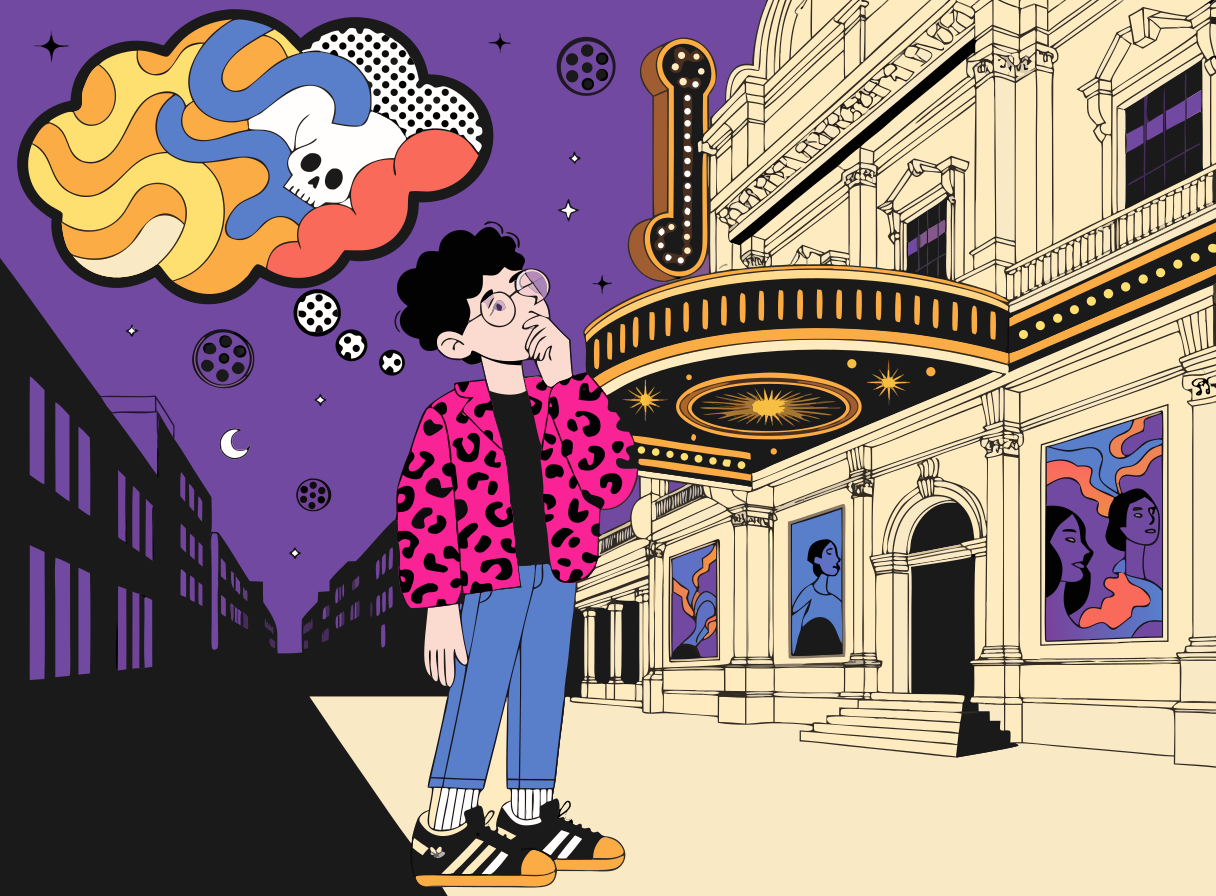
The spinning top in "Inception" wobbles, the screen cuts to black, and a decade later people still argue about whether Dom Cobb made it home. That argument is the achievement. An ambiguous ending turns a passive audience into active participants, and the deliberate choice to leave the crucial question open has become one of film's most reliable tools for lasting impact.
The Psychology of Not Knowing
There is real science under the unease. Studies of audience behavior at the University of California found that open-ended films generate over 70% more post-viewing discussion than tidy ones. We are wired to want resolution, and when a film withholds it, the mind keeps working the problem, sometimes for years.
"It's called the Zeigarnik effect," says cognitive psychologist Dr. Sarah Henderson. "Our brains remember unfinished tasks more vividly than completed ones. When a film denies us closure, we can't help but keep working on that puzzle long after the credits roll." That staying power is measurable: films with ambiguous endings draw roughly 37% more social-media discussion and theorizing than conventional ones, enough that marketing teams now plan post-release engagement around the open question. Neurological studies add a physical dimension. Faced with an unclear ending, the prefrontal cortex, which handles problem-solving, stays active for hours or days, which is why these endings feel so personal and surface during unrelated moments.
The Filmmakers Who Mastered It
Few films work ambiguity as well as "Inception." The final shot is not just misdirection; it is the film's argument about reality and dreams made literal. Christopher Nolan knew what he was doing, noting later that "the real point of the scene isn't whether the top falls, it's that Cobb doesn't stay to watch it." One creative choice turned a blockbuster into a puzzle people still assemble.
Sofia Coppola took the opposite route in "Lost in Translation," ending on a whisper the audience cannot hear. On a crowded Tokyo street, Bill Murray's character leans in to tell Scarlett Johansson's Charlotte something, and Coppola has never said what. The mystery itself carries the film's point about connection, and sound engineers have tried to recover the words while Coppola maintains that knowing them would diminish the scene. "Blade Runner" may be the most influential case in science fiction: the question of whether Deckard is a replicant has fueled decades of analysis, with Ridley Scott and Harrison Ford on opposite sides. That unresolved tension deepens the film's themes of humanity and identity rather than weakening them.
Ambiguity Has to Be Earned
Leaving things unresolved is not the same as ending well. "Ambiguity must be earned," insists screenwriter Robert McKee. "It should flow naturally from the story's themes rather than feeling like a cheap trick to generate buzz." The best examples thread uncertainty through the whole film so the open ending feels inevitable, which takes planning from the first draft.
The craft is technical as well as structural. Hans Zimmer's score winds the tension tight under Inception's final shot; composition can plant a clue or withhold one; editing meters out exactly how much the audience gets to see. Directors like David Lynch and Stanley Kubrick built whole careers on endings that feel satisfying and unsolved at once. Streaming amplified the payoff. Netflix data shows ambiguous endings drive about 43% more repeat viewings than clear-cut ones, which has pushed a new wave of filmmakers to build in detail that rewards a second and third watch, and pushed platforms to seek scripts with that quality.
From Coffee-Shop Debates to Subreddits
Social media changed how audiences wrestle with these endings. Instead of arguing over coffee, viewers gather online to unravel them together. The r/FanTheories subreddit, with more than a million members, regularly revives decades-old films with fresh readings, turning viewing into a communal act where the conversation rivals the content.
Scholars call the result collaborative interpretation: meaning emerges from community discussion rather than solitary analysis. "Inception" and "Blade Runner 2049" have become shared puzzles spawning endless video essays and forum threads, and some filmmakers now plant conflicting clues specifically to feed that work. Critics and academics have adapted too, treating ambiguous endings as material that benefits from multiple viewings and group debate. Film schools teach the technique, which has helped legitimize the open ending as a sophisticated tool rather than a narrative dodge.
The Point Is the Question
As audiences grow more sophisticated, the challenge sharpens: build uncertainty that provokes thought instead of frustration. "The goal isn't to frustrate the audience," Nolan once said, "but to invite them into the creative process." In an era of instant gratification, an ambiguous ending is a deliberate speed bump that forces us to slow down and engage. Done well, it does not just end a story; it starts a conversation that can outlast the film, a reminder that sometimes the question is worth more than the answer.